Maritime history · Cape Stavri · Naxos
Eleutherios V.The armed caique found after seventy-two years.
The documented history and rediscovery of a Greek motor vessel requisitioned by German forces, attacked by HMS Sportsman in November 1943 and finally identified by divers off northern Naxos in 2015.
Research by Manolis Bardanis · 2015
HMS Sportsman · Occupied Naxos · AegeanCape Stavri · Northern Naxos
Wartime record · search · identification
A story recoveredfrom forty metres below.
For years, rumours described a German torpedo boat loaded with weapons off northern Naxos. Historical research and one fortunate descent eventually revealed a different vessel—and a documented wartime loss.
The story before the evidence
Local divers had long spoken of a wreck near Cape Stavri. According to the stories, it was a German torpedo boat resting on the seabed with weapons, ammunition and even a motorcycle with a sidecar. Repeated searches produced no firm identification and several dives found only sand and rock.
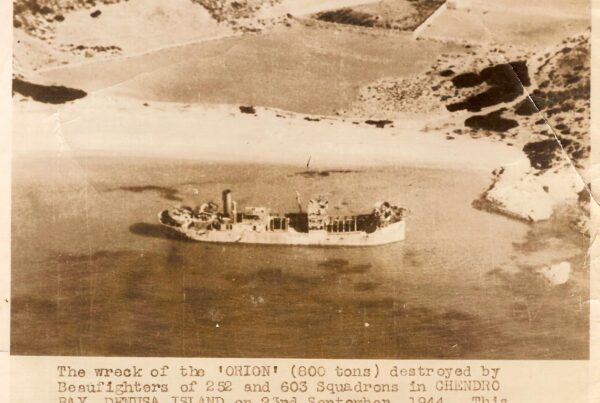
A possible link to a German Schnellboot attacked by RAF Beaufighters in September 1944 was investigated, but no independent source confirmed it. The decisive clue emerged in 2009, inside the Naxos Historical Archive.
The attack recorded in history
An entry in the wartime diary of the Naxos Military Organisation reported that a German-controlled armed sailing vessel had been attacked near Apollonas by a British submarine. Further archival research identified the vessel as Eleutherios V., a 70-gross-ton Greek motor caique requisitioned by German forces.
At dawn on 15 November 1943, HMS Sportsman, commanded by Lieutenant Commander Richard Gatehouse, sighted the vessel travelling from Naousa, Paros, toward northern Naxos. Eleutherios V. flew the Greek flag, carried an MG 15 anti-aircraft machine gun and transported military supplies—mainly small-arms ammunition—toward Astypalaia.
After thirty-two minutes of observation, Sportsman surfaced at 07:24, approximately 1,800 metres away. Twenty rounds opened a hole below the waterline. Burning, Eleutherios V. sank within three minutes.
The people aboard
The Greek crew comprised Captain Nikolaos Georgiou Karavokyrakos, engineer Georgios Margaritis and sailors Konstantinos Konstantaras, Georgios N. Karavokyrakos and Michail Foteinakos. Six German servicemen were also aboard.
Engineer Georgios Margaritis was the only person killed. Konstantinos Konstantaras lost his left arm, while two German servicemen suffered minor injuries. The survivors escaped in the vessel’s tender or swam toward the steep coastline, approximately two hundred metres away.
The descent that ended the search
On 18 August 2015, calm weather offered ideal conditions for another exploratory dive. The team consisted of Vasilis Vintzilaios, Vanessa Evangelatou, Manolis Bardanis and Charalambos Spanidis. After reviewing previous unsuccessful search areas, they selected a new GPS position and descended along the anchor line.
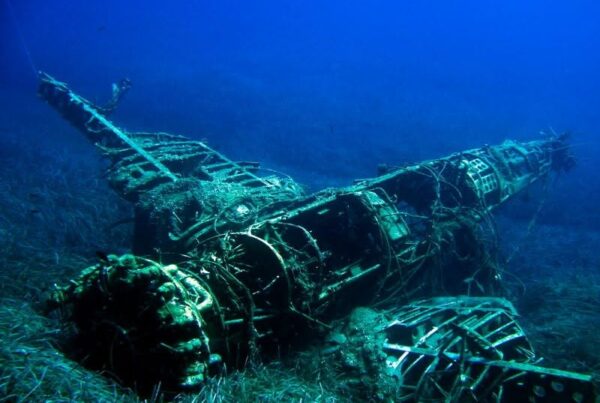
Boxes appeared first at the base of a rock, followed by barrels and scattered wreckage. At thirty-nine metres the main debris field became visible. Seventy-two years underwater and the submarine’s gunfire had erased the wooden hull. What remained were the propeller and shaft, engine components, a traditional anchor, fuel barrels, ammunition boxes and countless mortar rounds.
The wreckage extends approximately twenty metres along an axis from 290° at the propeller to 110° at the anchor, with debris spread seven to eight metres across. No motorcycle was found. The historical documents and physical evidence, however, matched completely: the long-sought wreck was Eleutherios V.