Maritime history · Lionas · Northern Naxos
OuranosAdrift toward the northern coast.
The documented history of a Dutch-built cargo ship whose final voyage ended after repeated engine failure, broken towlines and worsening weather—while her six-person crew reached Naxos safely.
Research by Manolis Bardanis · 2010
Engine failure · tow attempt · rescue1 NM north of Lionas
1952 · 1960 · 1981
A ship with two livesand a final passage to Naxos.
Launched in the Netherlands, raised after an earlier collision and returned to service under several names, Ouranos survived nearly three decades before machinery and weather decided her final voyage.
Built as Uranus
The merchant vessel was launched on 2 July 1952 at Noord Nederlandse Scheepswerven in Groningen, the Netherlands. Construction of hull number 260 was completed that October for N.V. Kustvaart Unie-Groningen, before ownership passed to Pinkster Co Amsterdam.
Measuring 52.48 metres, the vessel carried up to 675 metric tonnes and was powered by a 420 BHP De Industrie engine. Her working life would take her through several owners, flags and names: Uranus, Mario, Uranus I, and finally Ouranos.
The first sinking
On 21 June 1960, while carrying salt and timber through the Kiel Canal, Uranus collided with the cargo ship Themis. The impact turned her 180 degrees, forced a thirty-degree list to starboard and sent the vessel down.
Two lives were lost: the captain's wife suffered a fatal heart attack, while the third engineer was unable to leave his cabin. Ten other crew members were rescued by Themis. Uranus was later raised, repaired at Kiel and returned to service—a ship given a second life.
The final voyage
In 1973 the Hatzioannou brothers purchased the ship, renamed her Ouranos and placed her in Greek service. On 16 February 1981, she left Chalkida for Patmos carrying 800 tonnes of bagged cement and a crew of six.
A bearing failure forced repairs at Karystos. After departing again at 06:00, the main engine failed near position 37°23′ N, 26°02′ E when its camshaft broke. With the weather worsening twelve miles northeast of Naxos, the vessel Kostas G. arrived and began towing her toward the island.
Both towlines broke in the severe conditions. As darkness approached, the captain requested helicopter assistance. The crew abandoned ship in the lifeboats and, at 16:30, all six were taken safely aboard Kostas G.; the arriving helicopter was no longer required.
North of Lionas
Without power or tow, Ouranos drifted toward the northern coast of Naxos. She grounded approximately one nautical mile north of Lionas and sank on 20 February 1981, initially leaving her bow about one metre above the surface.
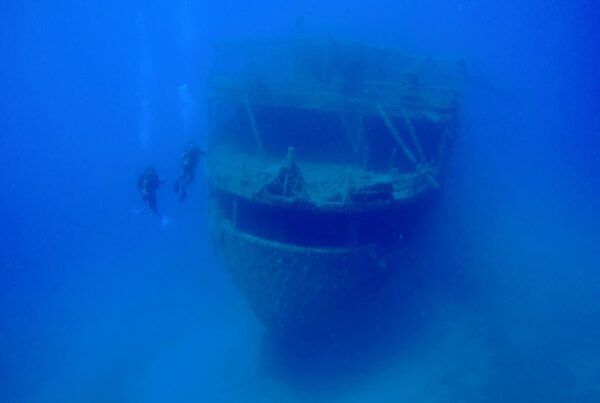
Years of strong northerly winds, shallow water and the rocky seabed have almost completely dismantled the wreck. Its largest coherent mass is now the hardened cargo of cement, still stacked in pallet-like rows with hull structure trapped beneath. Sheet metal, beams and rigging lie scattered around the site; part of the bow rests at thirty metres, while the anchor chain extends from the shallows into deeper sand.